
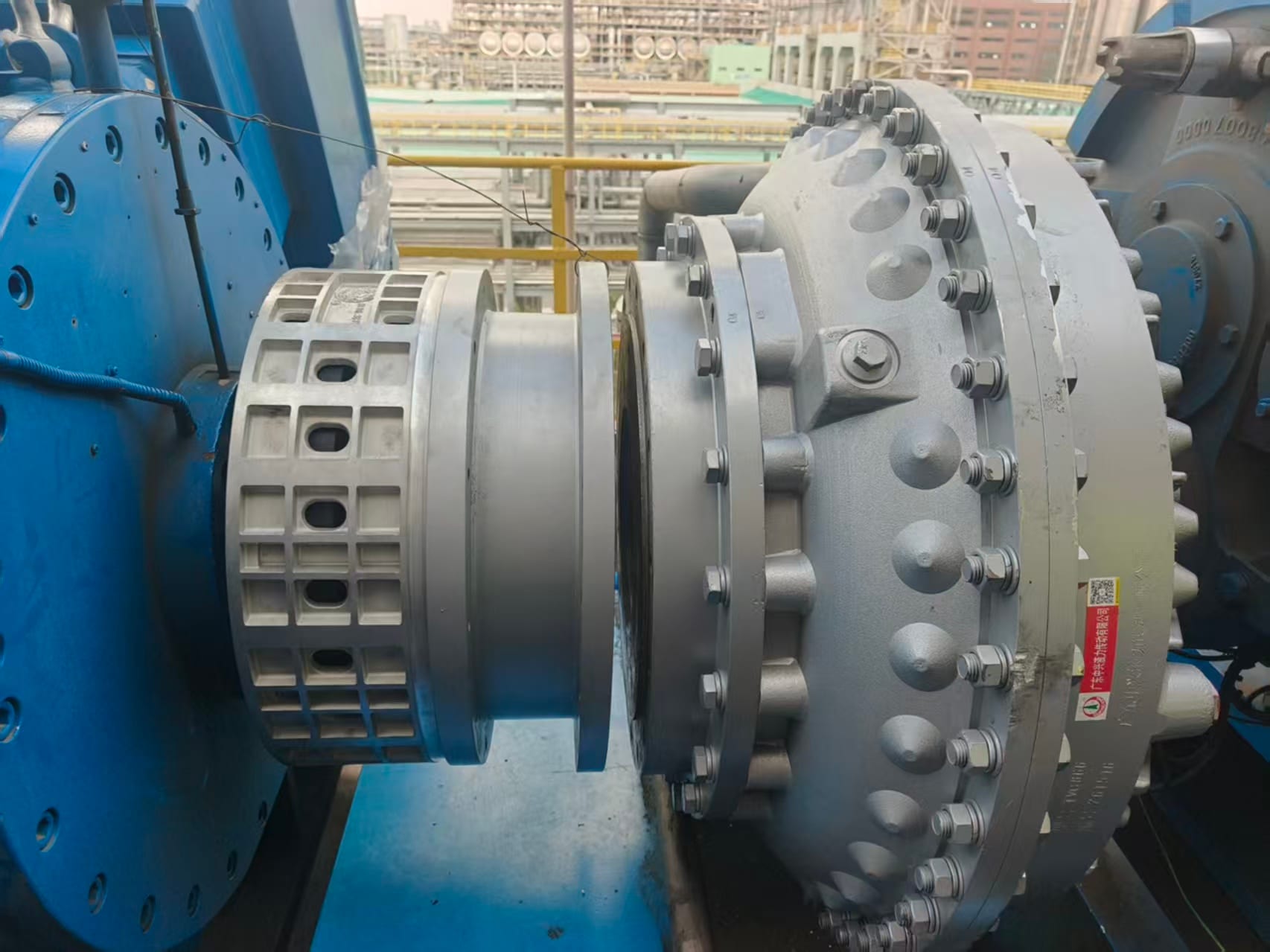
In addition to transmission efficiency, the soft-start capability and overload protection performance of a fluid coupling directly affect equipment operating safety. These characteristics can be preliminarily verified through several start-stop cycles and a single stall condition without complex disassembly. The following four field indicators are provided for equipment management reference.
1. Verify whether motor starting current rises smoothly without spikes. The starting current curve is a direct basis for evaluating soft-start performance. With a qualified fluid coupling, oil gradually participates in power transmission, the motor accelerates under approximately no-load conditions, and starting current should rise smoothly without pronounced transient spikes. If current surges at start-up and approaches or even exceeds several times the rated value, the soft-start function is ineffective, and grid impact and motor winding losses remain. A clamp meter or current recorder can be used to observe the starting process on site.
2. Assess whether equipment start-stop shocks are effectively buffered. A core value of the fluid coupling is isolating and buffering shocks to downstream equipment. A well-performing product can significantly reduce fracture failures of belts, reducers and chains. The assessment method is to compare the replacement frequency of wear parts before and after modification: if belt tearing, reducer gear tooth breakage and chain pin fracture are markedly reduced, flexible transmission is effective; if shocks are still transmitted directly to the end of the drive train, selection or internal structural matching is inadequate.
3. Check whether rapid pressure release and power disconnection occur under seizure or locked-rotor conditions. Overload protection is a key safety function of the fluid coupling. When downstream equipment seizes or stalls, a qualified product should rapidly release pressure and oil, disconnect power transmission, and reliably protect the motor and main machine. Normal performance means only the fusible plug is damaged, while the motor is not burned out, the reducer is not damaged and the main machine structure remains intact; operation can resume after replacing the fusible plug. If the motor is forced into locked-rotor operation or even burns out during seizure, the protection chain has failed.
4. Determine whether heavy-load starting stalls the motor. If heavy-load starting is difficult or the motor is stalled, the internal flow-path design of the coupling is likely defective and torque-limiting performance substandard. A high-quality product can use peak motor torque for stable loaded starting and gradually bring the equipment up to speed under heavy-load conditions; products with rough flow-path design and poor torque-limiting characteristics cannot establish sufficient oil circulation or transmit adequate starting torque. In such cases, verify the coupling’s torque-limiting performance first rather than suspecting the motor alone.
Conclusion: Evaluate soft-start and overload protection by focusing on four field signals: smooth starting current without spikes, a marked reduction in wear-part failure rates, damage limited to the fusible plug under seizure, and no motor stall during heavy-load starting. When selecting a product, require the manufacturer to provide starting current curves and overload protection test data, and verify performance with measured data.