
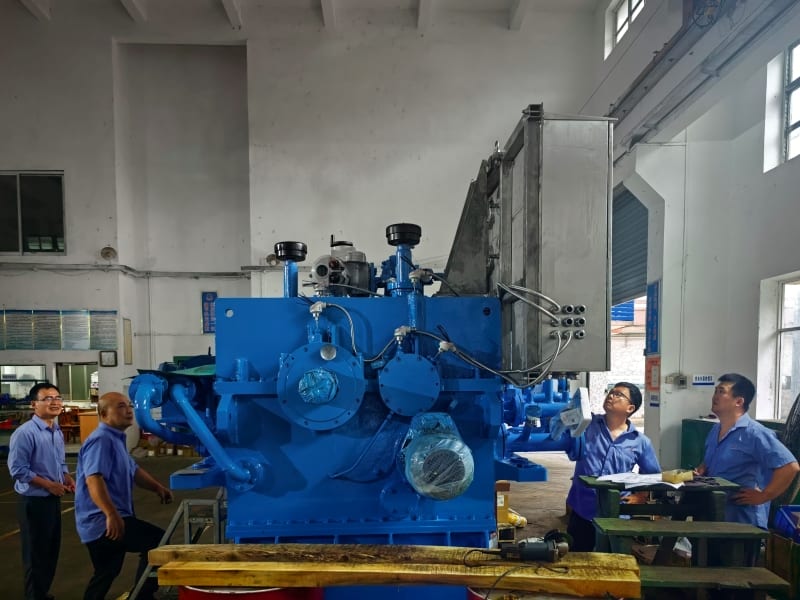
Whether a fluid coupling performs satisfactorily after installation should not be judged solely by supplier claims or catalogue specifications. Actual operating performance is the most reliable basis. For both site operation and factory acceptance, four field indicators centered on transmission efficiency and operating temperature rise can help equipment managers make a rapid assessment.
1. Casing temperature rise under identical load and ambient temperature. Temperature rise directly reflects hydraulic loss and heat dissipation capability. Under the same load and ambient temperature, a lower casing temperature rise after a period of full-load operation indicates lower internal hydraulic loss and better transmission performance. If the casing temperature remains excessively high during continuous operation, or the fusible plug frequently releases oil, the product is likely to have unreasonable flow-path design, insufficient heat dissipation, or excessive internal leakage, which will accelerate seal aging and shorten service life.
2. Differential between no-load and full-load motor current. Under identical operating conditions, a smaller differential between no-load and full-load current indicates lower electrical energy loss and higher transmission efficiency. An abnormally high full-load current and a notably larger differential suggest significant internal slip loss, with part of the electrical energy converted into heat. This will increase electricity and maintenance costs over time. A clamp meter can be used for preliminary on-site comparison.
3. Frequency of fusible plug oil discharge. The fusible plug is an overload protection component and should not operate frequently under normal conditions. If the casing overheats and the fusible plug repeatedly melts and discharges oil during continuous operation, the coupling is likely operating under high-slip and high-heat conditions, a typical sign of unsatisfactory performance. This also causes oil loss, environmental pollution and the safety risk of hot oil splashing.
4. Full-load slip ratio: ≤3% for quality products, 7%–8% for inferior products. Slip ratio is a key reference for transmission efficiency. A lower slip ratio means a smaller speed difference between input and output shafts and lower energy loss. Every additional few percentage points of slip ratio means more energy is converted into heat, resulting in higher temperature rise, lower efficiency and shorter seal life. This indicator can be verified through on-site speed measurement or factory test data.
Conclusion: Evaluate fluid coupling performance by casing temperature rise under identical load, no-load/full-load current differential, fusible plug operation and full-load slip ratio. When selecting a product, prioritize professional manufacturers that provide factory test data and records of full-load slip and temperature rise to ensure stable operation, lower energy consumption and reduced maintenance.